
Chiang Mai vs Bangkok: Which City Should You Live In?
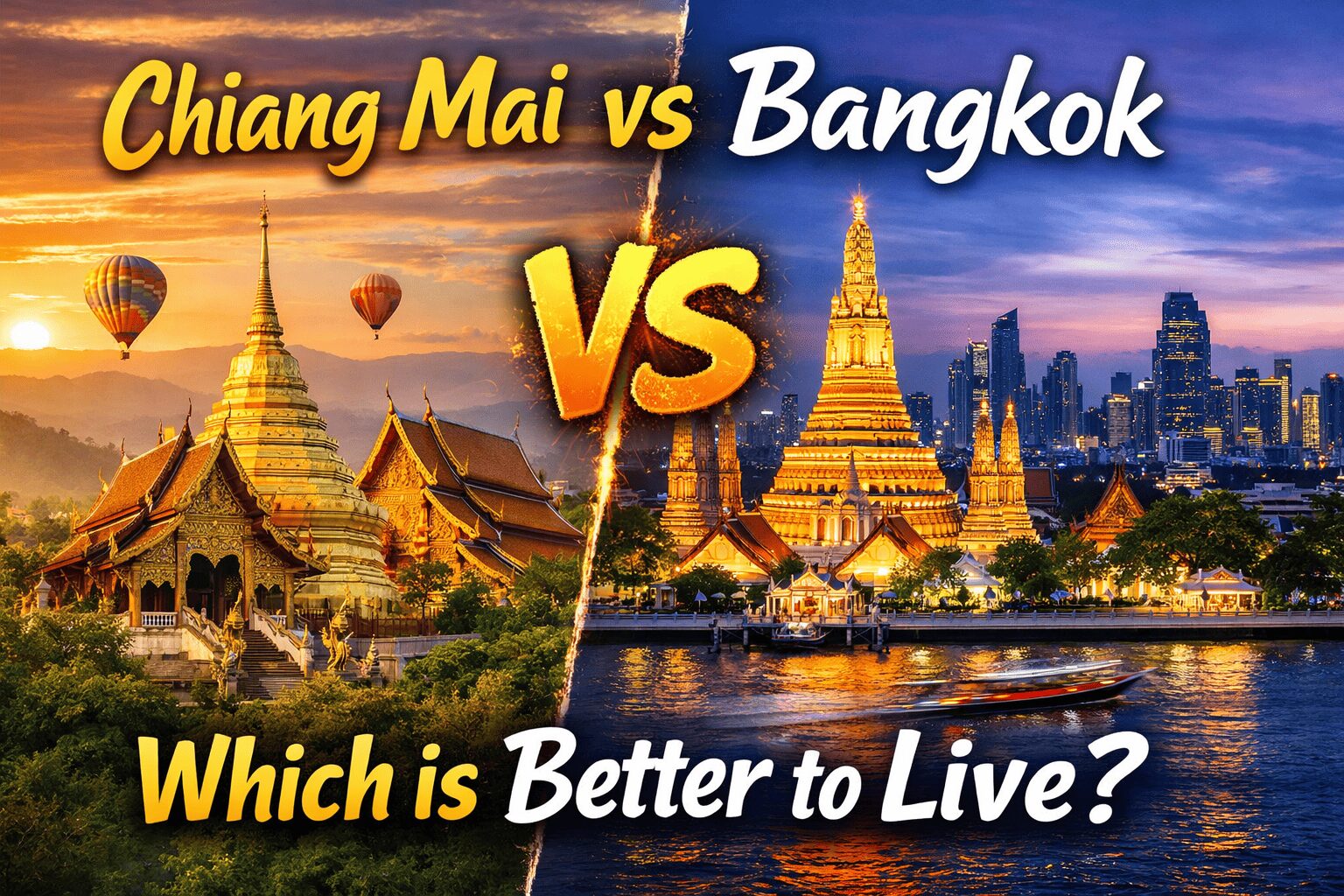
Ask any long-term expat in Thailand the same question — “Chiang Mai or Bangkok?” — and you’ll get a passionate answer either way. These two cities represent genuinely different ways of living in Thailand. Bangkok is a megacity that never stops moving. Chiang Mai is an ancient northern capital surrounded by mountains, temples, and a famously relaxed pace of life. This guide compares both cities across the factors that matter most for long-term living: cost, convenience, environment, and lifestyle.
1. Cost of Living Comparison
Rent This is where the gap is most obvious. In Chiang Mai’s central neighborhoods — Nimman, the Old City, and Santitham — a well-equipped one-bedroom condo typically rents for 8,000–15,000 Baht per month ($220–$415 USD). The equivalent in Bangkok’s BTS-accessible neighborhoods would cost 15,000–30,000 Baht ($415–$830), sometimes more. Chiang Mai’s rent is roughly half of Bangkok’s for comparable quality.
For those on the tightest budgets, Chiang Mai offers furnished studios from as low as 5,000–7,000 Baht ($140–$195) per month in local neighborhoods. Finding anything near this price in Bangkok’s central areas is nearly impossible.
Food Both cities have cheap and accessible street food. A meal at a local stall runs 40–80 Baht ($1.10–$2.20) in both cities. The difference is that Chiang Mai has developed a particularly strong café culture, with hundreds of specialty coffee shops and brunch spots that are noticeably trendy and moderately priced. You may find yourself spending more on coffee in Chiang Mai than you expected — it’s that kind of city.
Monthly Budget Summary A comfortable monthly budget in Chiang Mai runs roughly 25,000–45,000 Baht ($695–$1,250 USD). The equivalent Bangkok lifestyle costs 40,000–70,000 Baht ($1,110–$1,945). For budget-conscious expats and remote workers, Chiang Mai offers a significantly better financial equation.
2. Convenience, Transport, and Infrastructure
Getting Around Bangkok has one of Southeast Asia’s most comprehensive urban transport networks: the BTS Skytrain, the MRT subway, river ferries, and an extensive bus system. You can live and work in Bangkok without ever owning a vehicle. This is a major advantage for those who don’t want the hassle of driving in Thai traffic.
Chiang Mai has no rail transit. The city bus system exists but is infrequent and not relied upon by most residents. The practical options are renting a motorbike (2,000–3,000 Baht/month, ~$55–$83), cycling, or using Grab. For many people, the freedom of a motorbike suits Chiang Mai’s relaxed, spread-out character well — but it’s a different mentality than Bangkok’s transit-first living.
International Connectivity Bangkok’s two airports (Suvarnabhumi and Don Mueang) are among Asia’s busiest, with direct connections to most major cities worldwide. Chiang Mai International Airport handles excellent domestic connections and regional routes to neighboring countries, but long-haul international flights typically require a Bangkok connection. For frequent international travelers, this matters.
Healthcare and Administration Bangkok wins decisively here. The city hosts dozens of internationally accredited hospitals with full English-language services, specialist care, and state-of-the-art equipment. Chiang Mai has good international hospitals (Chiang Mai Ram, Bangkok Hospital Chiang Mai, McCormick Hospital), but specialist care sometimes requires a trip to Bangkok. Embassies, consulates, and government immigration offices for major countries are primarily located in Bangkok.
Internet and Digital Infrastructure Chiang Mai has earned its reputation as a digital nomad capital for good reason: fast fiber internet and 5G mobile coverage are available throughout the city, and the concentration of nomad-friendly cafés with reliable Wi-Fi is extraordinary. Bangkok has the same quality infrastructure, but Chiang Mai arguably does the café work-environment better.
3. Environment, Lifestyle, and Community
Chiang Mai’s Character Chiang Mai sits in a valley surrounded by forested mountains. The natural environment is genuinely beautiful, and the city’s scale — roughly 250,000 people in the urban core — means it never overwhelms. The Old City, enclosed by ancient walls and a moat, contains over 300 temples and retains a palpable sense of history. Day trips to waterfalls, elephant sanctuaries, mountain villages, and trekking trails are easy and popular.
The city’s lifestyle is slower and more intentional than Bangkok. Coworking spaces, yoga studios, vegetarian restaurants, and wellness retreats have made Chiang Mai a hub for people who want to work remotely while living deliberately.
One important caveat: air quality. From February to April, agricultural burning in surrounding provinces creates thick haze that can make PM2.5 levels dangerously high. This is a serious issue that deters some people from choosing Chiang Mai as a long-term base.
Bangkok’s Character Bangkok operates at a completely different frequency. It’s a city of 10 million people with an energy that’s hard to describe — relentless, exciting, occasionally overwhelming, always surprising. The food scene is world-class. The nightlife is legendary. Shopping malls the size of small cities exist alongside ancient temples and canal markets.
For professional opportunities, Bangkok is the clear winner. Regional headquarters of multinational companies, co-working spaces with actual business communities, networking events, and a constant influx of interesting people make Bangkok fertile ground for career development and entrepreneurship.
Traffic and air pollution are Bangkok’s most significant downsides for daily quality of life. Living close to BTS lines helps minimize the traffic problem considerably, but it remains a constant background feature of Bangkok life.
4. Which City Is Right for You?
Choose Chiang Mai if you: – Work remotely and want to maximize your cost savings – Value natural surroundings, outdoor activities, and a slower pace – Want to be part of a tight-knit expat and nomad community – Are drawn to Thai culture, Buddhism, and traditional crafts – Don’t need immediate access to international flights or embassy services – Are comfortable with the February–April air quality issue (or plan to leave for those months)
Choose Bangkok if you: – Prioritize convenience, infrastructure, and world-class amenities – Are pursuing career opportunities or building a business – Want maximum variety in food, entertainment, and social life – Travel internationally frequently and need a major hub airport – Are moving with a family (international schools are far more numerous) – Prefer to live car/motorbike-free using public transit
5. Final Thoughts
There’s no objectively “better” city — only the one that fits your life better. Chiang Mai rewards those who want to live well without spending much, and who are happy to trade big-city energy for mountain air and morning temple bells. Bangkok rewards those who want everything, all the time, at full intensity. Many long-term Thailand residents split their time between the two, using Chiang Mai as a peaceful base and Bangkok as their connection to the world. That, in itself, might be the best answer of all.