
Thailand’s 300 Baht Entry Fee: Latest Update (2026)
This article contains promotional links.
Thailand’s proposed 300 baht entry fee had still not been implemented as of reports from May 2026. The proposal would apply to foreign tourists arriving by air, and in March 2026 the new government pledged to submit it to cabinet — but as of May, formal approval had still not been granted. Both the start date and the payment method remain undecided. This article separates what has been confirmed from what is still unclear.

What Is Thailand’s Proposed 300 Baht Entry Fee?
The proposal would collect a flat 300 baht (about US$9) from foreign tourists arriving by air. Locally, it has been referred to somewhat bluntly as “ka yiab phaen din” — a “fee for stepping on Thai soil”.
- Amount: 300 baht (about US$9)
- Purpose: 70 baht of that would fund accident and medical insurance effective from the moment of entry, with the remainder proposed to go toward tourism infrastructure and safety measures
- Coverage: The plan is now limited to air arrivals; a separate 150 baht proposal for land and sea border crossings has been shelved
- Proposed exemptions: Thai nationals, infants under two, transit passengers, diplomats, work permit holders, and Long-Term Resident (LTR) visa holders are among the groups being considered, though the final list will only be confirmed after cabinet approval
The concept itself has been under discussion since 2023, with the idea of a dedicated fund for foreign tourists gaining momentum after incidents such as the 2015 Erawan Shrine bombing and the 2018 Phuket boat tragedy. The goal is to secure a dedicated pool of funds for tourists rather than relying on emergency support from the central budget.
What Has Been Confirmed as of Late September 2026?
The broad outline of the scheme is taking shape, but no official start date has been announced.
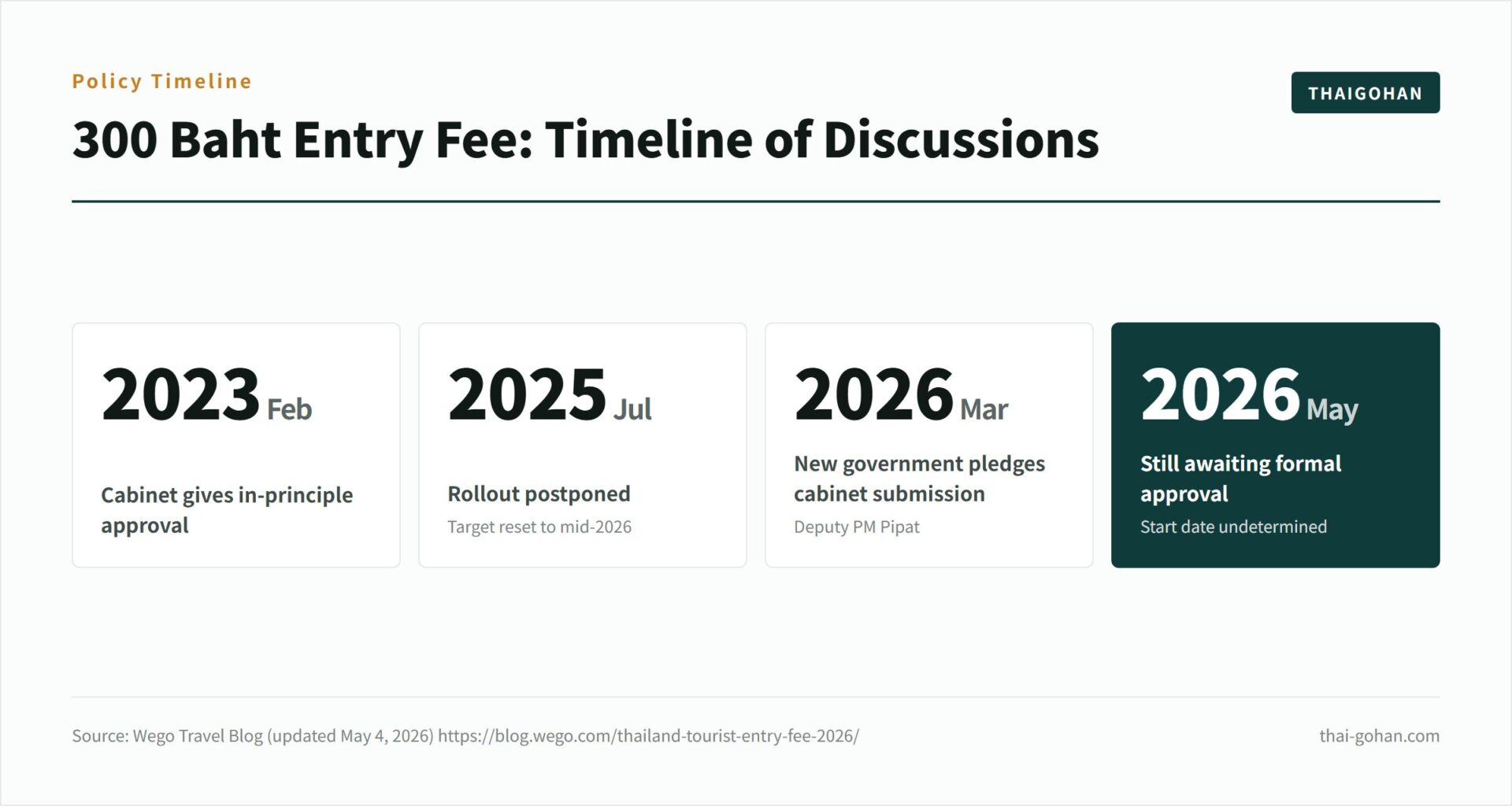
Here is how the timeline has developed so far:
- February 2023: The Thai cabinet gave in-principle approval
- July 2025: The Tourism Authority delayed the rollout, resetting the target for mid-2026
- March 2026: Deputy Prime Minister Pipat stated the fee would be submitted at the first cabinet meeting of the new “Anutin 2” government
- April 2026: The Ministry of Tourism and Sports showed signs of moving the scheme forward again, putting it on track for cabinet review
- May 2026: The proposal was still awaiting formal cabinet approval
This May 2026 report is the most recent official progress that can currently be confirmed.
It is also relatively clear that the scope has been narrowed to air arrivals only. The proposed 150 baht fee for land and sea crossings was shelved after concerns that it would unfairly burden cross-border commuters and day-trippers from neighboring Cambodia, Laos, and Myanmar — a point the Deputy Prime Minister explicitly confirmed.
Thailand is far from the only destination charging tourists an entry-related fee.
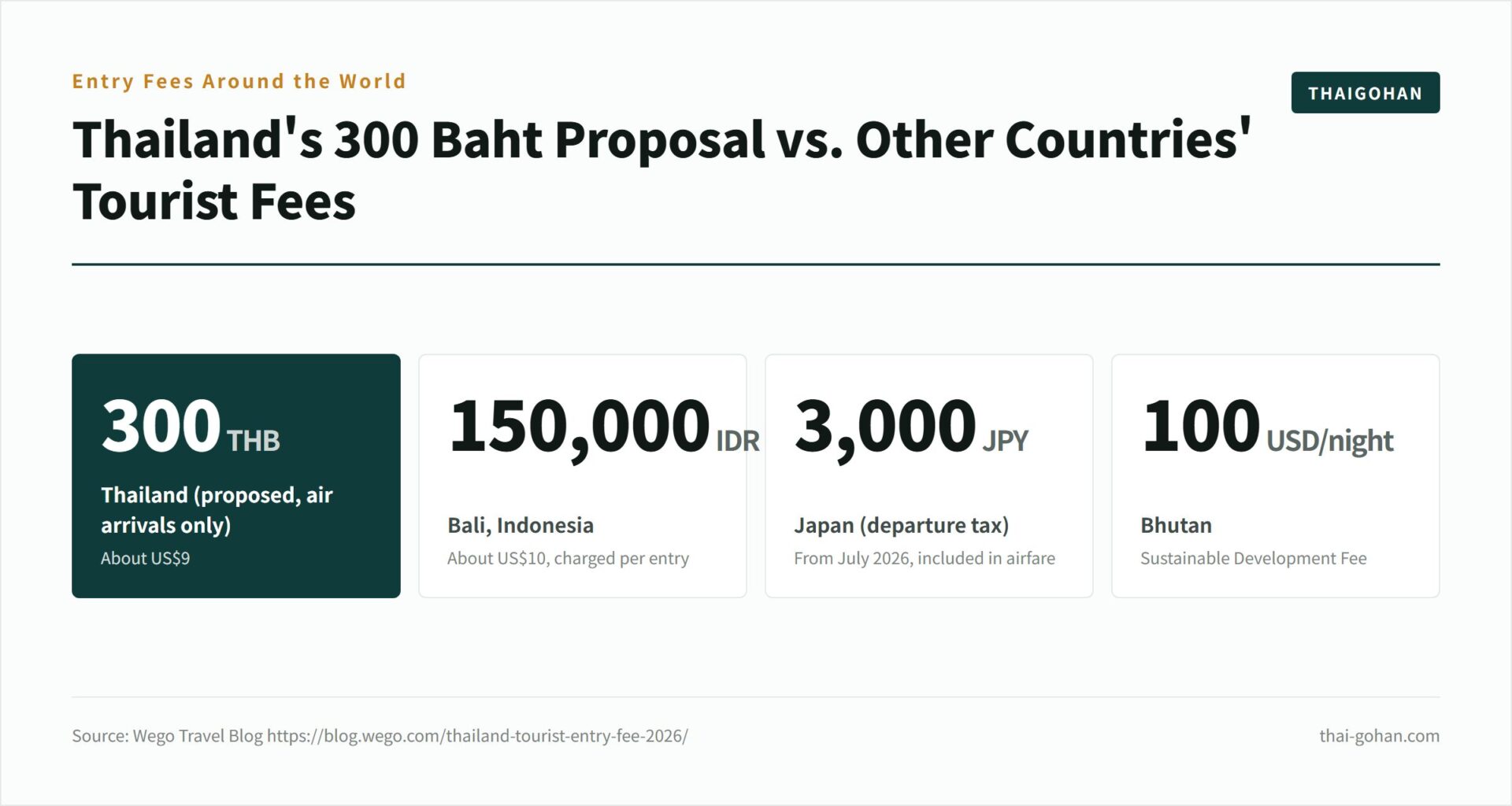
| Country / Region | Approximate Amount | Mechanism |
|---|---|---|
| Thailand (proposed) | 300 THB (about US$9) | Air arrivals only; likely to be bundled into airfare |
| Bali, Indonesia | IDR 150,000 (about US$10) | Paid online or on arrival, each time you enter |
| Japan | JPY 3,000 (about US$20, from July 2026) | Departure tax built into airfare; raised from JPY 1,000 |
| Venice, Italy | €5–10 | Applies to day-trippers on specific dates; overnight guests are exempt |
| Bhutan | US$100 per night | Sustainable Development Fee, charged per night of stay |
Seen this way, Thailand’s proposed 300 baht fee sits on the lower end compared with similar schemes elsewhere in the world.
What Hasn’t Been Decided Yet? (Start Date, Scope, Payment Method)
The start date, the final exemption list, and the payment method are all still unconfirmed as of late September 2026.
- Start date: The proposal has been repeatedly delayed since its in-principle approval in 2023, and even the May 2026 reports do not specify a concrete start date.
- Payment method: Rather than collecting cash at an airport counter, the leading proposal is to bundle the fee into the price of the airline ticket. However, whether airlines would add it at the point of sale, or whether it would run through a digital platform linked to TDAC (Thailand Digital Arrival Card), remains technically undecided.
- Exemptions: Thai nationals and transit passengers are among the candidates being floated, but the final list is only expected to be confirmed after formal cabinet approval.
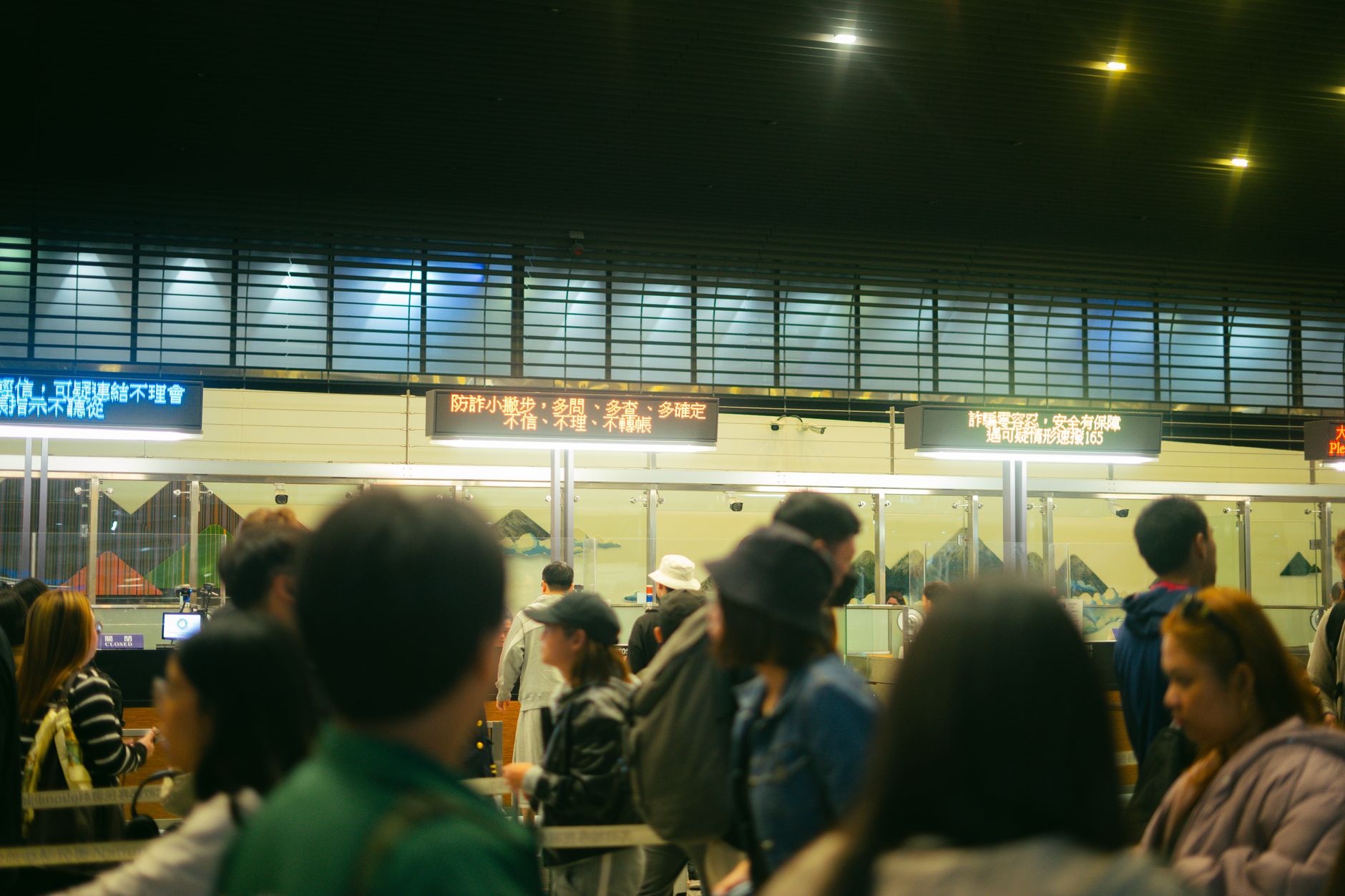
The important thing here is not to confuse “what has been reported as a proposal” with “what has been confirmed.” On payment method in particular, bundling the fee into airfare is only the leading option being floated — other approaches, such as a cash payment at the counter, have not been fully ruled out. When planning your trip, it’s safer not to assume any extra cost until an official start date is announced.
If you’re also thinking about healthcare access after arrival, our Thailand Healthcare and Hospital Guide is worth a read. Keep in mind that the insurance funded by the 70 baht portion is only meant to provide basic coverage from the moment of entry — it is not a substitute for travel insurance.
How Is This Different From TDAC (Digital Arrival Card)?
TDAC is an existing pre-arrival online registration process, and it is a completely separate system from the 300 baht entry fee.
- TDAC is a free electronic arrival card you complete before departure, and it exists independently of the 300 baht proposal.
- Linking the fee’s collection process to the existing TDAC platform is one of the technical options being discussed, but this has not been confirmed.
- This article does not cover the detailed steps or input fields for TDAC registration. For a step-by-step walkthrough that has already been verified, see our guide to registering for Thailand’s Digital Arrival Card (TDAC).
It’s easy to conflate the two, but there is currently no field in the TDAC form for paying 300 baht. It helps to think of them as two separate categories: a pre-arrival procedure (TDAC) and a cost associated with entry (the proposed 300 baht fee).
What Should You Prepare Now Before Arrival?
The 300 baht fee is not currently being charged, but you can still register for TDAC and stay informed today.

- Register for TDAC: This is an existing, mandatory step you can complete online, free of charge, within 72 hours of departure. See our guide to registering for TDAC for details.
- Check your airfare breakdown: If the fee ends up being bundled into airfare, a new line item may appear at checkout. It’s worth double-checking just before departure.
- Follow official announcements: Keep an eye on updates from the Ministry of Tourism and Sports and TAT. This scheme has already been delayed multiple times, and the details reported today may change again within a few months.
- Check seasonal travel information too: Beyond the entry fee, weather, clothing needs, and crowd levels change depending on when you travel. Our guides on what to wear in Thailand in September and the best time to visit Thailand can help fill in any gaps in your planning.
- Secure a way to stay connected: Since official announcements about the entry fee are likely to keep changing, having internet access as soon as you land makes it much easier to check for updates at the airport. With Saily, an eSIM that doesn’t require swapping a physical SIM card, you can set everything up in the app before you even leave home. Enter referral code “DOMUEH5022” to apply the promotion.
For overall trip preparation, it also helps to get a sense of local living costs and money matters. See our guide on the cost of living in Thailand as well.
Frequently Asked Questions
Do I need to pay Thailand’s 300 baht entry fee right now?
No. As of May 2026, there has been no official start announcement, so no payment is currently required. The proposal is still going through the approval process, and travelers arriving in Thailand today are not being charged this fee. Keep checking official channels for updates, since the situation could change with little advance notice once approval is finalized.
Does this apply if I enter Thailand by land or sea?
No. Under the current proposal, only air arrivals are covered. A separate 150 baht fee that would have applied to land and sea border crossings has been shelved, largely due to concerns about the impact on cross-border commuters and day-trippers from neighboring countries.
Does the 300 baht fee cover all my insurance needs in Thailand?
Only partially. Of the 300 baht, 70 baht is proposed to fund basic accident and medical insurance effective from the moment of entry. This is not a substitute for comprehensive travel insurance, and you should still arrange your own coverage before your trip, especially for anything beyond basic emergency care.
Is there a field to pay the 300 baht fee when I register for TDAC?
Not currently. TDAC remains a free, existing electronic arrival card, and it is a separate system from the proposed 300 baht fee. Even if the two systems are eventually linked on the back end, as of now there is no additional payment step built into the TDAC registration form itself, so you can continue registering exactly as before.
If I travel to Thailand multiple times, will I pay every time?
Under the current proposal, the fee would be charged on each entry. That said, this detail, like much of the scheme, has not been formally finalized, so frequent travelers should not assume this structure is locked in until an official announcement confirms it.
When is an official start date likely to be announced?
There is no indication yet, based on current reporting. The proposal has already been delayed repeatedly since its in-principle approval in 2023, so it’s best to avoid guessing a timeline and instead check official sources such as TAT closer to your travel dates.
Summary
As of reports from May 2026, Thailand’s proposed 300 baht entry fee has not been officially implemented. The leading proposal would apply to foreign tourists arriving by air, with the fee bundled into airfare, but the start date, the final exemption list, and the payment method all remain unconfirmed. It’s also a separate system from TDAC. For now, the practical steps are to register for TDAC, monitor official announcements, and make sure you have a reliable way to stay connected. We’ll update this article with the details as soon as the scheme moves forward.
More to Read
- Best Rooftop Bars in Bangkok? Picks by Purpose (2026)
- What to Wear in Thailand in August? Rainy Season Guide (2026)
- The Reality of Moving to Thailand: Pros and Cons (2026)
- When Is Songkran? Complete Guide to Thailand’s Water Festival (2026)
- LINE in Thailand: What Foreigners Need to Know
- Thailand’s Fruit Paradise: Durian and Mangosteen in June (2026)
Image Credits
- Photo: Shamsuddin Habib / Pexels
- Photo: Kenneth Surillo / Pexels
- Photo: Justin L U C K / Pexels